Just a small update to the previous post. Paperbacks seem to be orderable off all Amazons, Barnes and Noble and presumably other places. Waterstones does not appear to have added it to their catalogue unfortunately. I’m not sure what I would need to do to achieve that. In any event, many of the sellers on the Where to buy page now offer the paperback. I’m not wild about delivery terms, but hopefully (ebook) sales makes them take a few in stock.
Category: News
Paperback Version Available!
The paperback version of The Half Elven Orphan is available now. At the moment, it only seems to be orderable from Amazon.com. Hopefully other local Amazons will make it available soon, though I assume number of sales will have something to do with that. In any case, it should also be possible to order it at any regular bookshop. To do so, you need the ISBN number which is 9789083478302.
I haven’t put together a hardback edition, but it wouldn’t be a huge amount of work to do so. If anyone can’t live without a hardback, drop me a line and I’ll make the effort. I did check what it would cost and a proper hardback edition with a substantially larger font size would end up costing something like thirty-five euro’s though amazon and equivalent. I may be able to keep the price more reasonable if I only do direct sales. For now, I’ll wait to see if there’s any demand for one.
Newsletter Changes
I’ve posted the entirety of the draft version of The Half Elven Orphan and sent all the accompanying weekly newsletters. So, I’m changing the frequency of the newsletter. The draft version will remain accessible until the end of the year, but I feel it will only cause confusion if I leave it in place now that the actual book is released.
For the foreseeable future, I will send one newsletter a month (if there’s anything worth mentioning). There will be occasional excerpts, news and of course I’ll continue the world-building posts too. It’s time to get to work on The Value of Nobility, Tales of Vatan, Alagariel Book Two and Dropship Down, Total War, Clausewitz Book One. Dropship Down is rather closer to being done that I thought, so that shouldn’t be long now.
Oh and of course, here’s the Where to Buy page. If you want an ebook, I recommend the itch.io version as it just has more goodies, better updateability and supports authors better.
Ebook Released Today!
The Half Elven Orphan became available today on all the big sites. I’m attempting to list the places where it’s available on the Where to buy page. It’s also on Goodreads now. Obviously, I’m in dire need of reviews, so if you’re a reviewer and would like a review copy, please let me know.
Where to from here?
Next up, I’ll be polishing Dropship Down book one of the Clausewitz Series. I’ve been going through it a bit the last few days and honestly it doesn’t need all that much work. It’s about 160k words and I doubt much will be changed. The time for another long stretch of editing. Never say never, but I might manage to get this out in a few months.
After that, I’ll be focussing on The Value of Nobility, book two of the Alagariel Series. How fast I try to get that out honestly depends a little on whether The Half Elven Orphan generates any interest at all. It is going to have some major work done to it before it’s up to the same standard as Alagariel I.
It’s hard to see the future beyond that, but of the 10-15 books I have in a state that look a little like completeness, I’d like to publish one every six months or so. Time will tell if that can be achieved.
“It has been well said that an author who expects results from a first novel is in a position similar to that of a man who drops a rose petal down the Grand Canyon of Arizona and listens for the echo.”
P.G. Wodehouse, Cocktail Time
Available November 15th (Amazon)
The amazon page is now up. The print-on-demand version will be a few more days I expect as there was a problem with the cover and they’re very busy at Ingram Spark.
Anyway, it’s beginning to look like I may have published a book…
It’s a little poetic that this coincides with the release of Episode 59 of the version of The Half Elven Orphan that’s on the site here (20k words shorter than what’s on Amazon).
A interesting tidbit: Episode 59 actually became Episode 1 of The Value of Nobility (Tales of Vatan: Alagariel Book Two). It’s not in the longer book that’ll become available at all the e-book stores over the next few days.
Halloween Sale 50% Off!
Hey everyone, I decided to join in on the Halloween sale over on itch.io:
I’m still in the early stages of my journey through services like itch.io, so I thought I’d give it a try for a few days.
This book doesn’t have a Halloween theme (no more than fantasy in general does). If you really stretch it, Samhain has something to do with Fae which has something to do with elves which have something to do with half-elves, so let’s go with that.
The Half Elven Orphan itch.io release!
I just released The Half Elven Orphan on itch.io.
You can find it here.
I decided to go with itch.io first for a number of reasons. First off, it allows me to give epub readers a pdf version with the cover art and a map. Second, I can update things in future and buyers can easily re-download. Third, they pay authors far better, which for now, means more (human) artwork and real editors in future.
For those of you who want a print version or want it in their customary library, the big sites will follow soon(tm). It’s much harder to update things there, so I’m being rather more meticulous about the whole thing.
The Order of the Darwish
From the Encyclopedia Royalis Iurraka (edition of 975)
On the Order of the Darwish
The Order of the Darwish is a monastic fraternity devoted to the One God, whose origins lie in the exodus of ascetics and mystics from the Caliphate of Ruhm. Persecuted for their belief that divine unity is found through duty, love and service rather than conquest, they fled across Aqaba and Hrazdan before eventually finding refuge in Iurrak.
In the reign of King Hugo I (19658–19705 AC), the fraternity was granted lands near Erythrae and recognised as a religious order under royal protection. In return, the Darwish vowed lifelong service to the Crown, providing its most trusted guardian who are sworn to defend the lives of members or House de Seyssel with their lives.
Their discipline combines prayer, austerity, and bladecraft in a practice they call the Path of the Sword and the Soul. Though few in number, they are revered throughout Iurrak for their piety and skill. Members serve as bodyguards, embodying the principle that selfless duty is an expression of their faith.
Today, their leader bears the title of Most Penitent Servant, they play no part in court, but any child born to the de Seyssel line is a assigned a body guard from their ranks who serves as long as he is physically able and is replaced if by the order if necessary. The Order remains withdrawn from worldly affairs, but its members are a familiar sight at Seyssel Hall.
Daria’s Website
Daria, my extremely cool cover artist who as also just agreed to do the cover for Alagariel II, (and something else cool on which more later), has finally decided to get a website.
dariajordan.eu
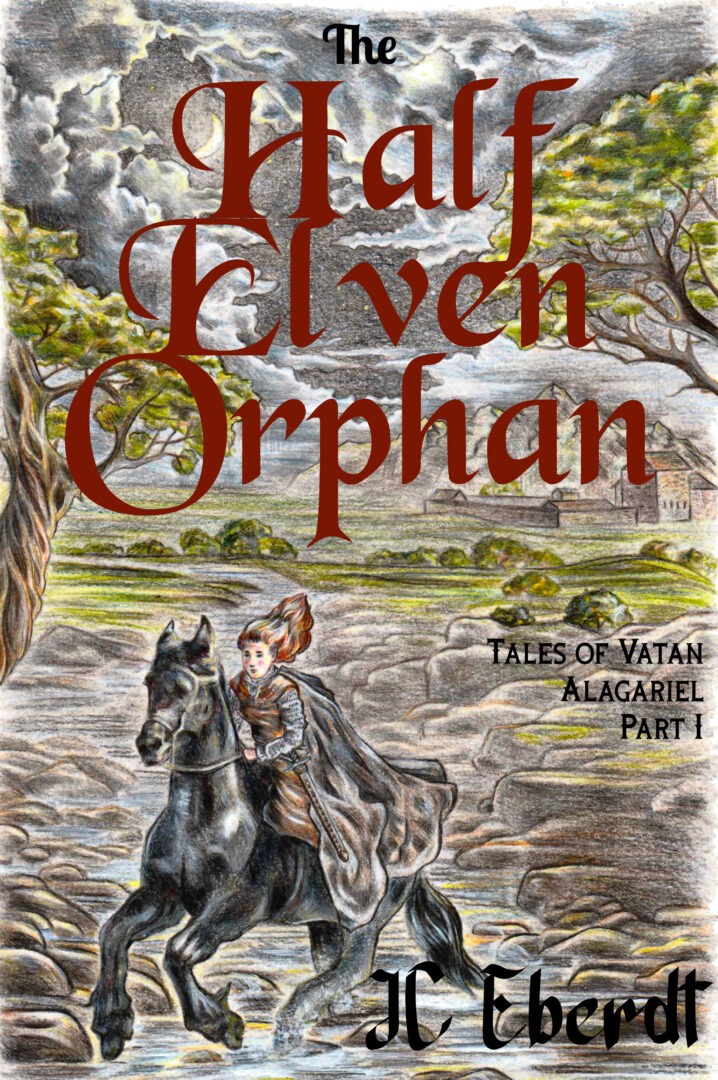
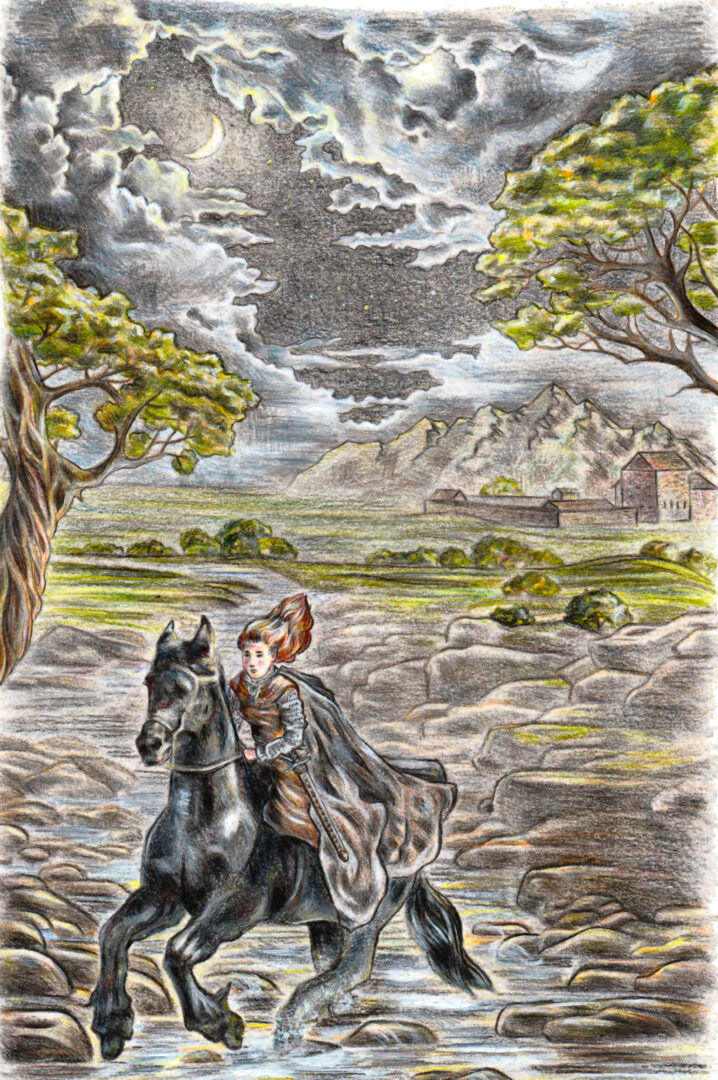
As a reminder, here’s the cover art for The Half Elven Orphan.
The Royal Customs Service of Iurrak
This is linked to this Vatan Companion Page
From the Encyclopedia Royalis Iurraka (edition of 975)
On the Royal Customs Service
The Royal Customs Service is one of the Crown’s most indispensable instruments, tasked with the oversight of trade, the collection of the Royal Tax, and the maintenance of His Majesty’s economic authority throughout the realm. Its duties, set down by wise kings, are both noble and necessary, and its history testifies to the foresight of Iurrak’s sovereigns.
The Service owes its foundation to the foresight of King Gabriel I, who in the year 601 not only instituted the Customs Service but also concluded the Peace of Equals with Selinus, bringing an end to eighty years of war and thus securing both the realm’s borders and its prosperity. To him we owe the enduring principle that the King’s justice must extend to the realm’s markets as well as its fields. Gabriel’s genius lay in recognising that trade, left ungoverned, breeds disorder, but under royal supervision strengthens the whole kingdom.
The later wisdom of King Humphrey I must also be praised. In 718, when the treasury lay in peril, Humphrey decreed that the sale of commissions in the Royal Regiments be entrusted to the Customs Service. By this act he avoided the imposition of extraordinary taxes upon his loyal nobles, while at the same time replenishing the Crown’s coffers. Though some grumbled at first, it was a masterstroke of statesmanship, for the lords maintained their privileges while the regiments were strengthened. The realm, preserved from weakness, owes to King Humphrey I its continued stability.
The Royal Tax, unlike feudal dues or manorial levies, is laid chiefly upon dense and precious goods: metals, spices, dyes, and other wares whose transport yields great wealth in small measure. The Customs Service patrols borders, rivers, and roads with diligence, ensuring that His Majesty receives his rightful due. To evade such duty is not merely theft but treason against the Crown, for the Royal Tax is the very lifeblood of the kingdom.
Beyond their fiscal duties, the officers of Customs provide the Crown with knowledge of inestimable worth. By observing the flow of goods, they reveal the strengths and weaknesses of provinces, the fortunes of merchants, and the health of the realm itself. In war as in peace, this intelligence has allowed kings to act with foresight. It is no exaggeration to say that without the Customs Service, the realm would be blind to its own condition.
The officers of the Service are for the most part of common birth, yet drawn from the younger sons of wealthy merchants, men of education and sound judgment. This prudent practice ensures that they have both the learning and the practical familiarity with commerce to perform their duties well. It is true that their inspections sometimes cause friction with nobles, yet this is an unavoidable consequence of enforcing the King’s law impartially. Only in Erythrae do nobles hold regular office within the Service, and there only at the highest levels. The post of Lord High Customs Inspector is wisely reserved for lesser royal kinsmen, ensuring that the Service remains ever faithful to the Crown.
Lastly, the Customs Service holds the honour of administering the commissions in the royal regiments. This sacred duty binds the realm’s soldiery directly to the King’s authority, ensuring loyalty and discipline. Though some lords lament their exclusion from this process, it must be remembered that it is by this very means that the Crown ensures the unity of its armies, sparing the kingdom the rivalries that have so often plagued lesser realms.
The Royal Customs Service, founded by Gabriel I and perfected by Humphrey I, stands as a monument to royal wisdom. To question it is to question the Crown itself, and none but the most self-interested could deny the Service’s necessity. It is, in every sense, a pillar of order and the surest guarantee of the prosperity of Iurrak.